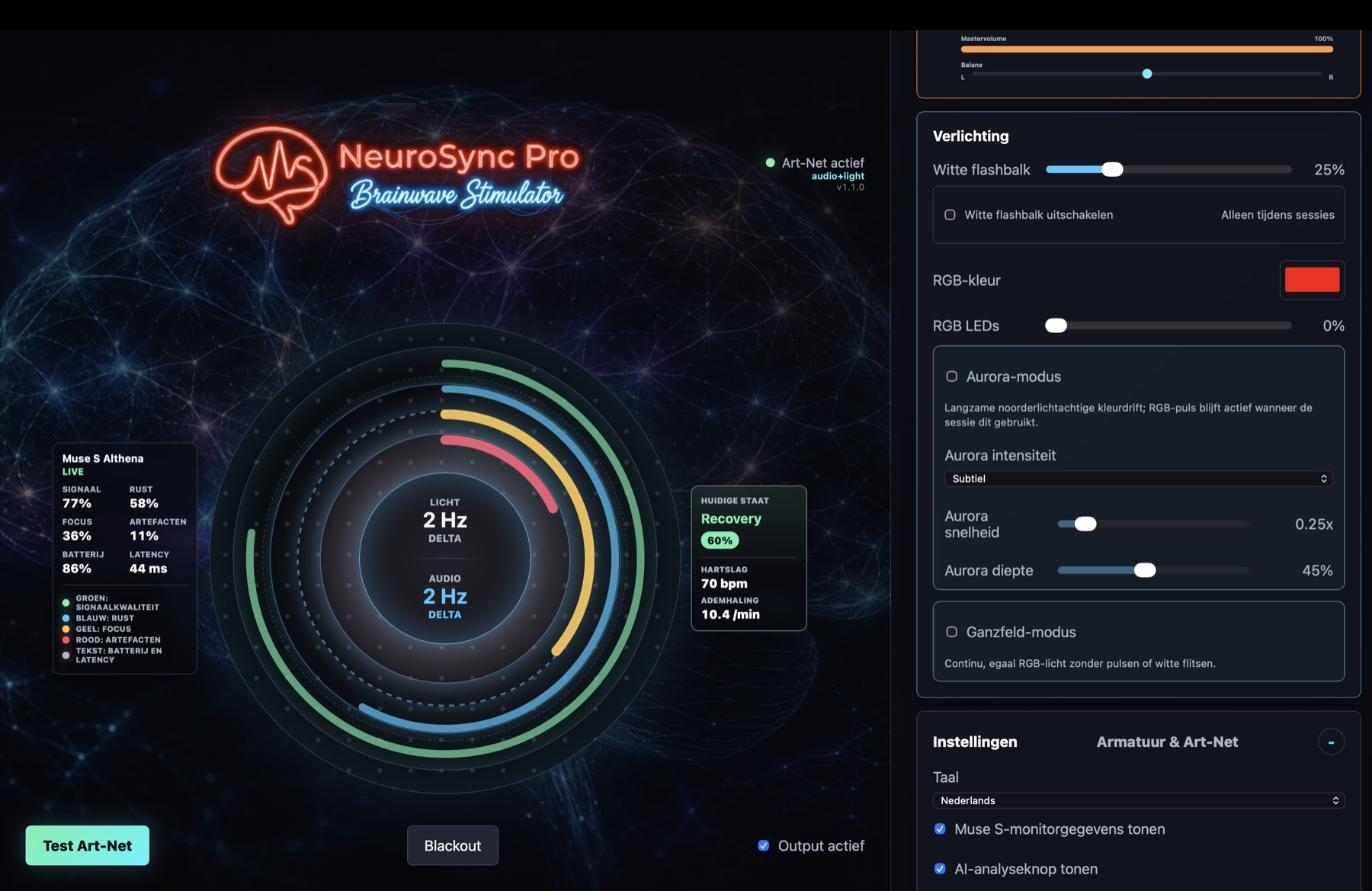
With Muse S Athena support, NeuroSync Pro Audio+Light adds a new layer to professional audiovisual session work: live monitoring alongside audio, light, breathing and session design. The Audio+Light edition already combines rhythmic audio, synchronized RGB-W light, music, breathing guidance, Infinity Ganzfeld™, Aurora Immersion™ mode and a detailed Neural State Studio™. Muse S Athena support adds an observation layer that can help professionals understand how a session unfolds in real time and generate a detailed post-session analysis of approximately 7 to 10 A4 pages.

This does not turn NeuroSync Pro into a medical EEG system or diagnostic device. Its value is practical: better observation, richer session context, clearer post-session discussion and a more structured report of what was offered and what was measured during the session.
Instead of looking only at stimulation frequency, music volume, light color or the selected session, the facilitator can also view indicators such as calm, focus, artifacts, signal quality, heart rate, breathing and a global state indicator. The experience becomes more observable without reducing it to simplistic numbers.
From audiovisual session to observable session
NeuroSync Pro Audio+Light is built around an integrated session architecture: rhythmic audio, optional synchronized light, music, breathing guidance, phase transitions and detailed session design. Muse S Athena does not add another audio or light channel. It adds a monitoring layer.
That monitoring layer is intentionally visual and compact. Next to the central NeuroSync Pro rings, a Muse S monitor can show key values without overwhelming the session interface. The facilitator can stay with the session instead of staring at raw data.
The Muse S monitor is designed as a professional observation window: enough information to recognize patterns, not so much that the session disappears behind technical noise.
Guides to the Muse Monitor views
The Muse S Athena monitor includes two important live views. The circle view is designed for quick interpretation of signal, calm, focus, stress, artifacts and current state. The 3D EEG Spectrum Waterfall provides more detail about frequency bands, power, dominant frequency and entrainment match.
What the Muse S Athena monitor can show
| Monitor element | What it indicates | Why it matters |
|---|---|---|
| Signal quality | A practical indication of how usable the incoming Muse S data are. | Helps prevent overinterpretation of weak or interrupted signals. |
| Calm | A relative indication of relaxed or settled involvement. | Useful in relaxation, meditation, hypnosis preparation and recovery sessions. |
| Focus | A relative indication of directed mental engagement. | Relevant for focus, learning, cognitive clarity and performance-oriented sessions. |
| Artifacts | Noise caused by movement, muscle activity, contact changes or other measurement disturbance. | Shows when the data should be interpreted cautiously. |
| Battery and latency | Practical device and connection status. | Prevents technical issues from being mistaken for session effects. |
| Heart rate | A global heart-rate display when available. | Adds context for relaxation, activation, stress or recovery. |
| Breathing | A breathing rate or breathing indication when available. | Helps relate breathing guidance to the session experience. |
The monitor is therefore an interpretive context, not a diagnostic instrument. A high focus value does not automatically mean optimal performance. A calm value does not prove deep hypnosis. Artifact peaks may simply mean the user moved or adjusted posture. The values must be read alongside the selected session, the phase, the quality of the signal and the user’s own report.
The state indicator: focus, relaxation, cognitive load, recovery, stress or mental fatigue
A compact state indicator can summarize the dominant pattern at the current moment. Instead of asking the user to interpret every line and percentage, the system can indicate whether the session currently appears to lean toward focus, relaxation, cognitive load, recovery, stress or mental fatigue.
| State | Practical meaning within a session |
|---|---|
| Focus | The user appears relatively task-oriented or mentally engaged. |
| Relaxation | Signals lean more toward calm or relaxed involvement. |
| Cognitive load | The experience may currently require more mental processing. |
| Recovery | The balance appears to move toward regulation or lower load. |
| Stress | Signals may reflect increased activation, tension or restlessness. |
| Mental fatigue | Signals may suggest reduced mental freshness or resilience. |
For live facilitation, this is useful. A practitioner can see whether an intense light phase may be demanding, whether a recovery block is beginning to settle, or whether a user remains in high load longer than expected. The indicator remains supportive, not diagnostic.
Why full analysis belongs after the session
A live monitor is for orientation. A full analysis belongs after the session has ended. Only then can the system evaluate the followed session, the available data, the timing of phases, the presence of artifacts and the relationship between physiological indicators and session design.
For this reason, analysis should only become available when real session data exist and the session has finished. This prevents reports from being generated from incomplete sessions, test moments or isolated fragments without context.
A 7 to 10 page A4 professional report
The analysis function is designed for an extensive professional report. Depending on session length and available data, the generated analysis can span approximately 7 to 10 A4 pages. This is intentionally more than a short summary. A useful report should explain when, where and in which phase patterns appeared, and how cautiously they should be interpreted.
| Report section | Content |
|---|---|
| Session summary | Name, goal, duration, structure and Audio+Light components. |
| Data quality | Signal quality, available measurement time, artifacts and latency. |
| Phase analysis | Discussion of calm, focus, load, recovery and artifacts per session phase. |
| State development | Dominant states such as focus, relaxation, cognitive load, recovery, stress and mental fatigue. |
| Heart rate and breathing | Interpretation of available heart-rate and breathing values in context. |
| Audio and light context | Relationship between frequencies, pulse shape, color, intensity, Infinity Ganzfeld™, Aurora Immersion™ and measured patterns. |
| Professional interpretation | Nuance, limitations, possible explanations and follow-up considerations. |
| Practical recommendations | Suggestions for session choice, intensity, duration, pacing and post-session evaluation. |
The phase-by-phase analysis is especially important. A session is rarely one straight line. A user may arrive alert, settle during induction, show more focus during imagery or cognitive processing and recover during integration. A report that respects that timeline is more useful than a single average across the whole session.
Analysis in relation to the followed session
The analysis does not interpret EEG-like values in isolation. It relates them to the actual session. The same focus value can mean something different in a focus protocol than in a deep relaxation session. Mild activation may be appropriate in a build-up phase, but less desirable near the end of a recovery session.
Audio+Light context matters as well. RGB light, white LED intensity, pulse shape, frequency, music volume, noise, breathing guidance, Aurora Immersion™ and Infinity Ganzfeld™ can all shape the experience. A full analysis should therefore ask what was happening in the session at the time a pattern appeared.
Professional use cases
For hypnotherapists, Muse S Athena support can help distinguish arrival, induction, deepening, suggestive work and integration. The user does not need to verbally report every moment. The practitioner can review patterns after the session with more nuance.
For coaches and trainers, the monitor can help evaluate focus and recovery protocols. Was the session mainly activating? Did recovery emerge? Did breathing slow down? Did the user remain in high cognitive load? These questions can support better session selection.
For wellness professionals, the analysis creates a way to document premium sessions more clearly: what was offered, how the session developed, what stood out and which practical recommendations may fit a next session.
Privacy, credits and deliberate analysis
A detailed report is not generated automatically. The user or professional deliberately starts analysis when enough data are available. Analysis credits can be used so each report is intentional and administratively clear. This fits professional use: a 7 to 10 page report has value and should be generated purposefully.
The analysis button can also be shown or hidden in settings. If no Muse S data or session data are available, analysis should not be active. This keeps the interface clear and avoids confusion.
What this feature does not do
Muse S Athena support in NeuroSync Pro Audio+Light is not clinical EEG diagnostics. The analysis is not a medical opinion, not a psychological diagnosis and not a replacement for healthcare. It cannot diagnose or rule out ADHD, burnout, epilepsy, anxiety, depression, sleep disorders or neurological conditions.
The feature is intended for observation, session reflection and professional experience design. Clear limits make it safer and more credible.
Do not use rhythmic light with photosensitive epilepsy, seizure history or unexplained loss of consciousness without medical clearance. Stop if headache, nausea, panic, agitation, derealization, dissociation, eye strain or other discomfort occurs. Never use sessions while driving, cycling or performing safety-critical activities.
Why this matters for Audio+Light
Audio+Light sessions combine sound, rhythm, light, color, phase transitions, breathing and sometimes deep relaxation or hypnosis. Until now, evaluation was often mainly subjective: how did it feel? what changed? what did you notice? These questions remain important, but Muse S Athena support adds another layer: what did the monitor show during the process?
This creates a more professional post-session conversation. Not to reduce experience to data, but to place data and experience side by side. Sometimes the data confirm the user’s report. Sometimes they add nuance. Sometimes they mainly reveal artifacts or technical issues. In all cases, the session becomes easier to discuss.
The real value is not “more data.” It is better context: session design, experience, physiological signals and professional interpretation coming together.
Frequently asked questions
Is the Muse S Athena monitor always visible?
No. The monitor can remain hidden and becomes relevant when Muse S Athena is detected and the user chooses to show monitor data.
Can the analysis be generated during the session?
No. A full analysis should be generated after the session, when session data, phase structure and signal quality can be reviewed in context.
Why is the report so long?
Because a professional analysis should include more than averages: phase development, data quality, audio and light context, breathing, heart rate, dominant states and practical recommendations.
Is this a medical report?
No. It is a session analysis, not a medical or psychological diagnosis.
Can reports be printed?
Yes. The analysis is designed to be shown and printed so it can be reviewed later by the user or professional.
Scientific and professional sources
- Systematic review on brainwave entrainment and psychological outcomes
- Research on oscillatory entrainment and the frequency-following response
- Review of steady-state visual evoked potentials in visual stimulation research
- NCCIH: relaxation techniques, evidence and safety
- CDC: information about photosensitive epilepsy
This article provides general product and user information. NeuroSync Pro is not a medical device, and the Muse S Athena monitor does not replace clinical EEG measurement, medical assessment or psychological diagnosis.